Data Study
We Analyzed 2,500 Dividend Stocks: How Many Are in the Payout Danger Zone?
The payout ratio is the single most useful number for judging whether a dividend is safe — it tells you what share of a company's earnings is going out the door as dividends. So we ran it across our full research database of 2,500 dividend-paying US stocks. The result: nearly a third are stretched, and more than one in five is paying out more than it actually earns.
The headline numbers
- 29% of dividend stocks are in the payout danger zone (payout ratio above 80%).
- 21% pay out more than they earn (payout ratio above 100%) — mathematically unsustainable without cutting, borrowing, or selling assets.
- The median payout ratio is 48% — most dividend payers are healthy, but the tail is risky.
- 41% are conservative, paying out under 40% of earnings, with plenty of room to keep raising.
- Low-payout stocks grow dividends more than twice as fast: a median 7.4% per year for payout ratios under 50%, versus 3.0% for those above 80%.
- 60% of stocks yielding 8%+ pay out more than they earn — hard data behind the classic yield-trap warning.
How we did it
We took the 2,500 US dividend-paying stocks in REWD's research database and looked at each company's dividend payout ratio — annual dividends divided by earnings per share — as of July 2026. Payout data was available for 1,631 of them (the rest either don't report comparable earnings or had missing data), and the percentages below are based on that set. Dividend growth figures use each stock's trailing five-year dividend growth rate.
One important caveat up front: the earnings-based payout ratio is the right lens for most companies, but not for REITs. Real estate investment trusts are legally required to distribute at least 90% of their taxable income, and their reported earnings are depressed by heavy depreciation, so they routinely show earnings-payout ratios above 100% while remaining perfectly healthy on a cash-flow (FFO) basis. We've flagged Real Estate in the table for that reason. Regulated utilities and cyclical energy companies also run structurally higher payouts than, say, an industrial or a software company.
The payout distribution
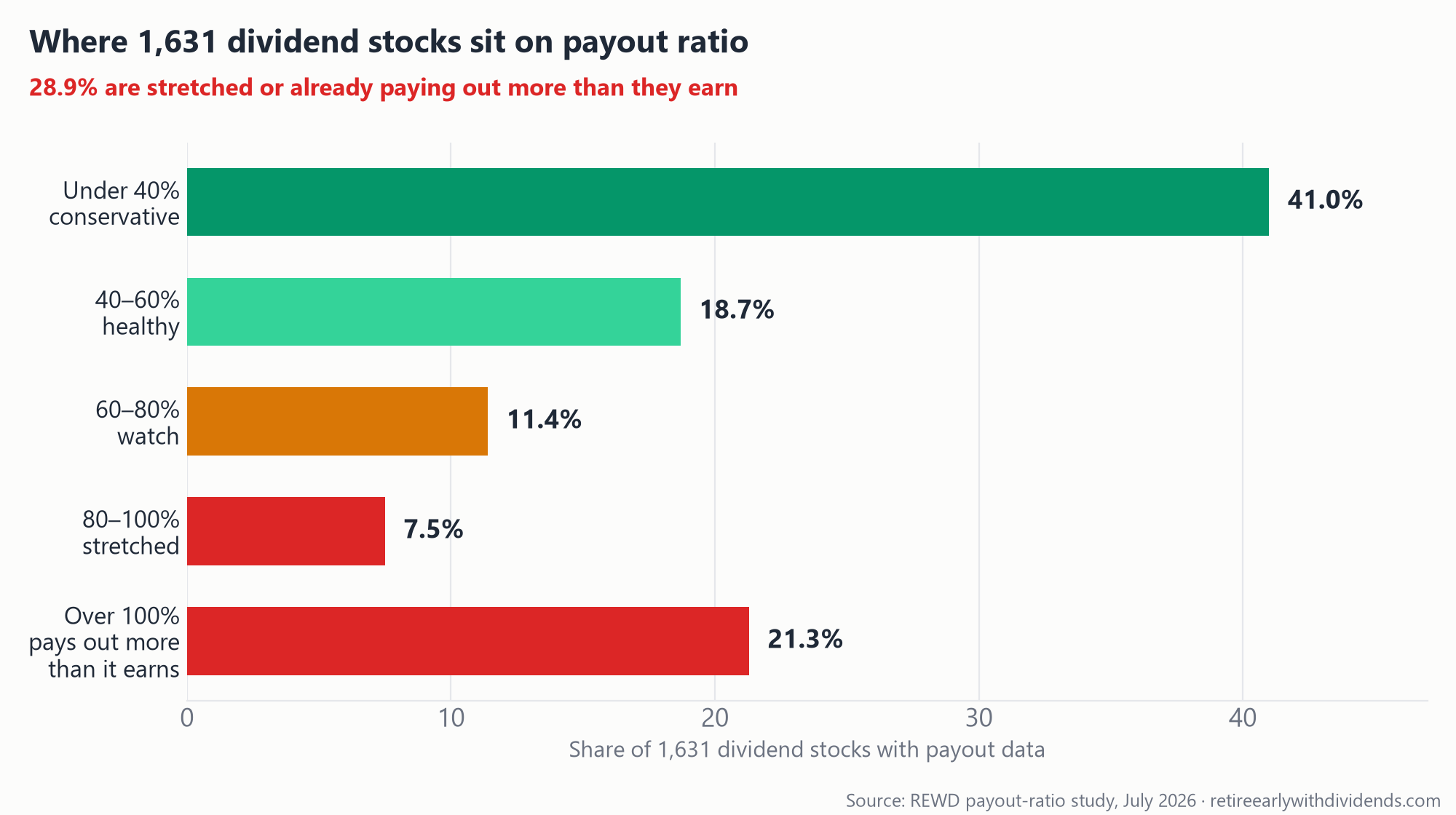
Here's how all 1,631 stocks with payout data break down. Note the barbell shape: a large healthy majority, and a stubborn ~29% tail that's either stretched or already paying out more than it earns.
| Payout ratio band | Share of stocks | Count |
|---|---|---|
| Under 40% — conservative | 41.0% | 669 |
| 40–60% — healthy | 18.7% | 305 |
| 60–80% — watch | 11.4% | 186 |
| 80–100% — stretched | 7.5% | 123 |
| Over 100% — pays out more than it earns | 21.3% | 348 |
The bottom two rows — 471 stocks, or 28.9% — are the danger zone. That's not a rounding error; it's nearly one in three dividend stocks carrying elevated cut risk.
Dividend safety by sector
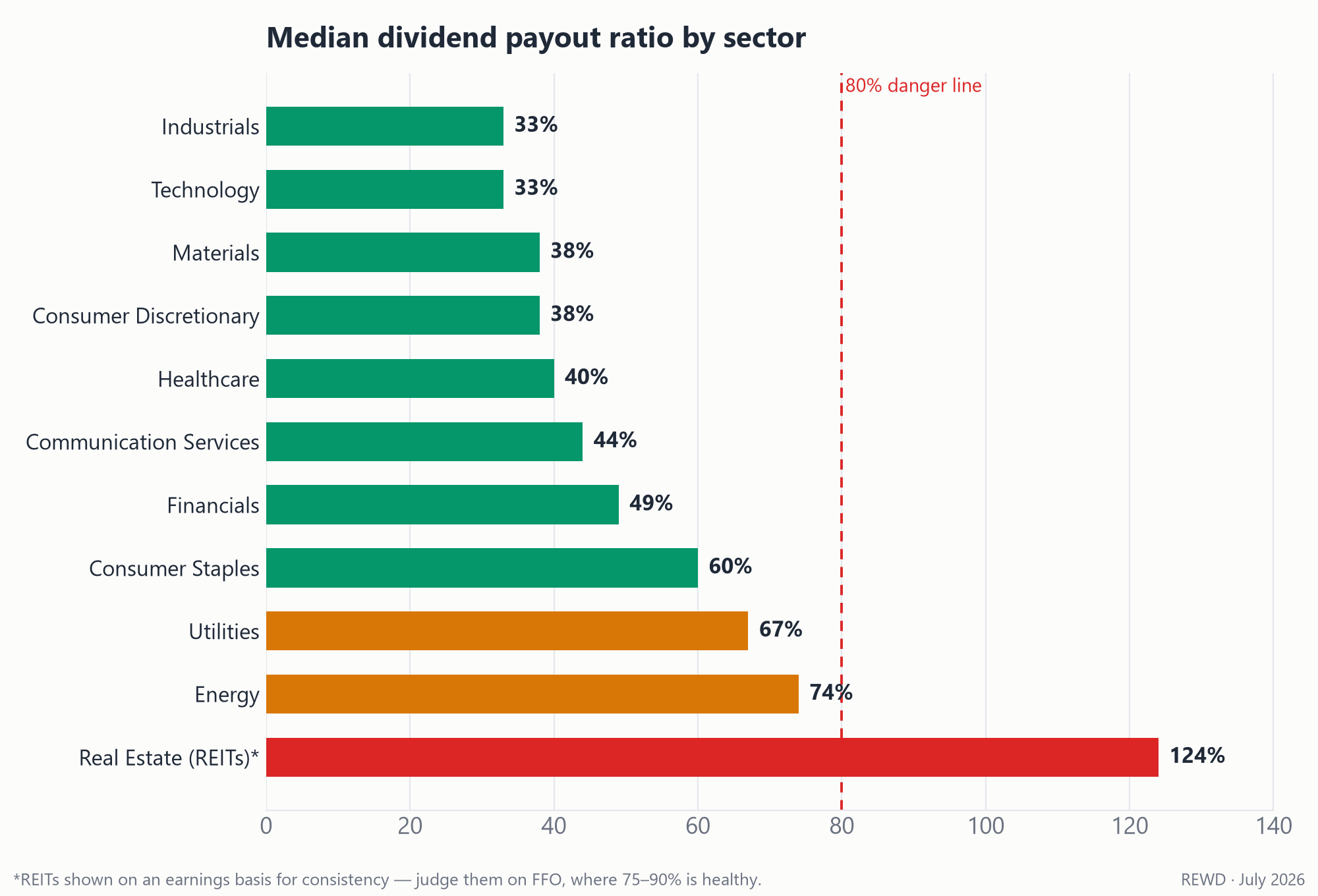
Payout ratios vary enormously by sector, which is exactly why comparing a stock only to the market average is misleading. Sorted from safest (lowest median payout) to riskiest:
| Sector | Median payout | Share over 100% | Median 5y div growth |
|---|---|---|---|
| Industrials | 33% | 6% | 7.9% |
| Technology | 33% | 8% | 10.0% |
| Materials | 38% | 15% | 4.3% |
| Consumer Discretionary | 38% | 12% | 13.1% |
| Healthcare | 40% | 13% | 6.3% |
| Communication Services | 44% | 23% | 4.0% |
| Financials | 49% | 25% | 4.1% |
| Consumer Staples | 60% | 11% | 3.8% |
| Utilities | 67% | 16% | 4.8% |
| Energy | 74% | 34% | 8.8% |
| Real Estate (REITs)* | 124% | 67% | 2.9% |
*Real Estate is shown on an earnings basis for consistency, but REITs should be judged on FFO — a 124% earnings payout is normal for the sector, not a red flag on its own.
The pattern is clear. Industrials, Technology, Materials, Consumer Discretionary, and Healthcare run the leanest payouts (median 33–40%), giving them the most cushion. Utilities and Energy pay out more by nature, and Energy in particular is cyclical — a third of energy dividend payers were above 100% at this point in the cycle. And notice the last column: the sectors with the lowest payouts (Technology, Consumer Discretionary, Industrials) also tend to post the fastest dividend growth, while the high-payout sectors grow slowest.
Low payout ratios grow dividends faster
That last point deserves its own headline, because it's the whole argument for dividend-growth investing in one statistic. Across the entire dataset:
- Stocks with a payout ratio under 50% grew their dividends a median of 7.4% per year over the last five years.
- Stocks with a payout ratio above 80% grew them just 3.0% per year.
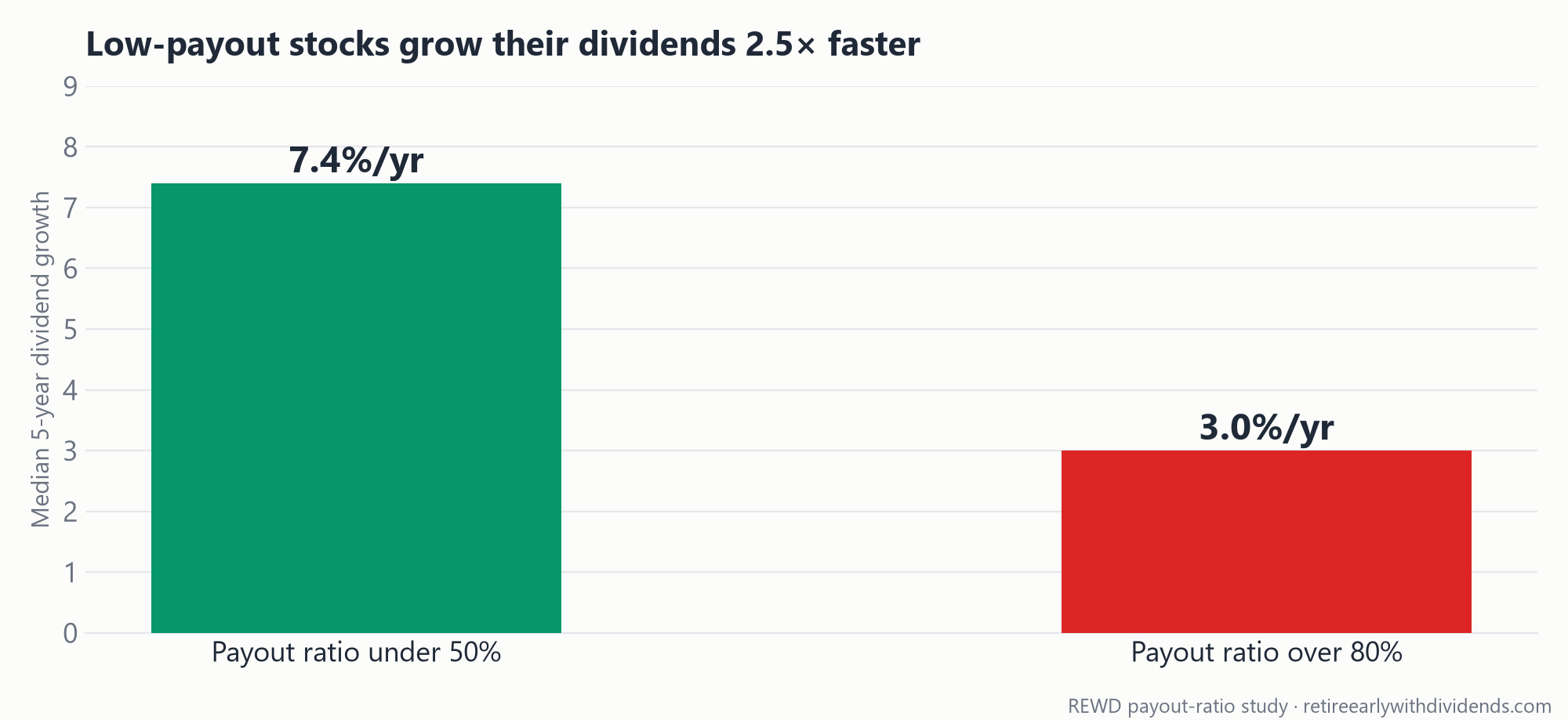
A company that only pays out a third of its earnings has two levers to raise the dividend: grow earnings, or expand the payout. A company already paying out 90% has only the first, and less room for error if earnings dip. Over a multi-decade holding period, that difference compounds into a dramatically higher yield on cost.
High yield plus high payout is the real trap
The scariest number in the study is this: among stocks yielding 8% or more, 60% were paying out more than they earned. A high yield is a ratio — it rises when the price falls — so an 8%+ yield often means the market is already pricing in a cut that the payout ratio confirms is coming. This is exactly the dynamic we cover in how to avoid dividend yield traps, now with the data to back it: the highest yields on any screener are disproportionately the least sustainable. Our Yield Trap Calculator flags this combination automatically.
What a safe payout ratio actually looks like
Pulling it together, here's a practical rule of thumb for judging a dividend's payout ratio — the same thresholds REWD uses to flag holdings:
- Under 60% (most sectors): healthy, with room to keep raising.
- 60–80%: watchable — fine for utilities and consumer staples, worth a closer look elsewhere.
- 80–100%: stretched — little margin for an earnings dip.
- Over 100%: a red flag for common stocks — the dividend is being funded by something other than current earnings.
- REITs: ignore the earnings payout; check the FFO payout instead (75–90% is typical and healthy).
How to check your own portfolio
The payout ratio is only useful if you actually track it across everything you own — and that's where a spreadsheet falls down, because payout ratios move every quarter as earnings are reported. REWD surfaces payout ratio, 5-year dividend growth, and safety signals free on every one of its 2,500+ stock research pages, no signup required. And when you connect a brokerage to the dividend tracker, it flags stretched payout ratios across your entire portfolio automatically, so a holding drifting into the danger zone doesn't slip past you.
For the full framework, read our guide to building a safe dividend portfolio, and if early retirement is the goal, see the best dividend trackers for FIRE.
Frequently asked questions
What is a safe dividend payout ratio?
For most sectors, a payout ratio under 60% is considered safe, 60–80% is worth watching, and above 80% carries real cut risk. In our analysis of 2,500 dividend stocks the median payout ratio was 48%. Regulated utilities (60–75%) and REITs are exceptions — REITs are legally required to distribute most of their income and are better judged on FFO than on earnings-based payout.
What payout ratio is too high?
A payout ratio above 100% means a company is paying out more in dividends than it earns, which is unsustainable without cutting the dividend, borrowing, or selling assets. In our data, 21% of dividend stocks paid out more than they earned. Above 80% is the point where most common stocks (outside utilities and REITs) enter the danger zone.
Which sectors have the safest dividend payout ratios?
In our analysis, Industrials and Technology had the lowest median payout ratios (around 33%), followed by Materials, Consumer Discretionary, and Healthcare (38–40%). The highest were Real Estate (124% on an earnings basis, though REITs are better measured on FFO), Energy (74%), and Utilities (67%).
Do stocks with high payout ratios cut their dividends?
High payout ratios don't guarantee a cut, but they remove the margin of safety and correlate with slower dividend growth. In our data, stocks with payout ratios under 50% grew their dividends a median of 7.4% per year over five years, versus just 3.0% for stocks paying out more than 80% — a strong signal that low payout ratios leave more room to grow.
How can I check if my own dividends are safe?
Look at each holding's payout ratio, dividend growth streak, and yield-on-cost. REWD surfaces payout ratio, 5-year growth, and safety signals free on every stock research page, and its dividend tracker flags stretched payout ratios across your whole portfolio automatically when you connect your brokerage.
Methodology & disclosure: Based on REWD's database of 2,500 US dividend-paying stocks as of July 2026; payout-ratio percentages reflect the 1,631 with available earnings-based payout data. Payout ratio = annual dividends ÷ earnings per share. REITs are shown on an earnings basis for table consistency but are better evaluated on FFO. This is educational analysis, not investment advice; figures are point-in-time and will change as companies report earnings.